Thursday, February 24, 2022

Comic Books I Missed The First Time Around

I started reading comics in 1977 when I was 6 years old, first as a reader of Justice League of America and then (by 1979) becoming primarily a reader of Marvel superhero comics like Avengers and Captain America. (I posted at length about that here.)  In mid-1983, shortly before I turned 13 years old, I got bored with Marvel and began buying non-superhero comics published by Archie and Charlton.  In the process I became a big fan of Steve Ditko, whose work was appearing in comics by both companies at the time. (I posted about that here.) 

In the 1980s my visits to comics shops were infrequent, around four or five times per year (if that) and when I did go there I tended to focus more on back issues, particularly the discount bins.  Most of my new comics purchases were at local convenience stores like Lawson's and 7-11, and local independent bookstores.  My small town had two such bookstores throughout the 1980s (and a short-lived third bookstore in 1984).  At that time, nearly every small town in my area had at least one bookstore that sold new books, and most of them had a comics spinner with the month's latest mainstream releases.

Despite all those options for finding new comics, I still somehow managed to never see some issues that I probably would have bought if I had seen them.  Or perhaps I did see them at the time and forgot all about them because they didn't seem as interesting to me back then as they do now.  And of course my spending money was limited, so it's possible that I passed them by for that reason alone (lack of funds), and then promptly forgot all about their existence.   

Nowadays when I look through back issue boxes, or search the listings found at the Grand Comics Database (GCD), I'm sometimes surprised by comics from the 1980s that I had no idea existed. Most of the info and cover images below are from their GCD entries.  I have also used the Newsstand feature at Mike's Amazing World of Comics, which is a bit like having a time machine to see what comics were on sale each week.

So, with all that background information out of the way, let us begin.

Probably the earliest comic book that I remember not getting was ACTION COMICS #500 (Oct. 1979) which came out when I was 8 years old.  I was more into Marvel at this point, but still bought the occasional DC comic if it looked interesting.  A couple friends told me that they had seen #500 at the local drugstore, and we were mainly impressed by the fact that a comic book had reached such a high number.  Thor was the longest-running Marvel series and I made sure to buy Thor #300 when it came out a year later.   I also bought JLA #200 (March 1982) when it came out.  But I never did buy Action Comics #500, and still don't have that issue all these years later.

Two of the most acclaimed fan-favorite series during this period were also largely avoided by me at this young age.  I was a fan of the most popular Marvel superheroes (Spidey, Hulk, FF, Cap) and tended to be less interested in the more obscure titles.  I learned about two of the second-tier titles, Daredevil and X-Men, when I signed out a copy of Son of Origins from my local library, since that book reprinted their first issues.  A friend had a copy of Daredevil #155 that I looked at, and when I saw #156 (Jan. 1979) at the local drugstore, I bought it and kept buying it.  Frank Miller became the book's penciler with #158 (May 1979) which I bought new off the spinner rack, as well as the next issue.  I think I missed #160 & 161, but I did buy #162 (Jan. 1980), a fill-in issue drawn by Steve Ditko, which was one of the first Ditko comics I ever bought.  And I bought (and enjoyed) #163 & 164, too.  But then something happened: I decided that the one title I would focus on "collecting" would be Captain America, and a neighbor friend offered to trade me some of his 1970s Jack Kirby Cap issues for my Daredevil issues.  I accepted the offer, which caused me to think that there was no point in continuing to buy new issues of Daredevil now.  So I missed DAREDEVIL #168 (Jan. 1981), the first appearance of Elektra and the first issue of Miller's long run as the book's writer.  I did buy the next issue, #169 (March 1981), when I saw it at the local bookstore, but then I stayed away from Daredevil for nearly two years, missing the majority of Miller's run.  I finally bought an issue again when I saw the striking cover of #189 (Dec. 1982) -- at a local supermarket, if memory serves -- and as soon as I read the first few pages regretted that I had not been buying the series all along.  Unfortunately I missed the next two issues as well -- I guess DD was easy to miss on the stands back then -- which were the final two Miller-drawn issues.  In 1983 I bought a mail subscription to Daredevil that began with #201 (Dec. 1983), but it was clear that I missed out on the mag's glory days.  Although I let my sub lapse after a year, I began buying the series again with #226 (Jan. 1986), during Miller's return as writer, and therefore was largely able to read the classic "Born Again" story in real time and not later on via the back issue bins. (I say "largely," because I did miss #227, buying it several months later at a garage sale of all places.)

The other fan-favorite Marvel title of the 1980s was X-Men, and it's a similar story there, with me coming to the party late.  The first issue I recall buying was #124 (Aug. 1979), during the middle of the famous Claremont-Byrne run, which I bought at a local drugstore when I was 8 years old.  I bought the next issue, too, also at a local drugstore.  But then I learned that a local comics shop was buying used comics (for, I think, 5 or 10 cents each -- this was back when the cover price of a comic was 40 cents) and I sold those two issues to the store.  So, having apparently decided that Uncanny X-Men wasn't good enough to keep in my collection, I didn't buy it anymore.  But then Amazing Adventures #1 (Dec. 1979) came out, and I began buying it every month from the first issue.  This series reprinted X-Men from 1963-onwards, the Lee-Kirby issues with some later origin recaps in the backup slot, which were an excellent introduction to the concept of the comic.  Unfortunately, the series was short-lived and AMAZING ADVENTURES #14 (Jan. 1981) was the last one published, but I never saw it, nor the issue before that.  The last one I had seen and bought was #12.  (To this day, the only issue I need to complete the run is #13.) 

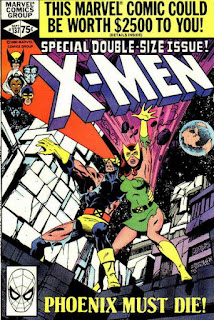
Gradually it must have dawned on me that Amazing Adventures was no more, so I began buying Uncanny X-Men again with #142 (Feb. 1981).  Unfortunately this was the next-to-last issue drawn by John Byrne; I had missed out on buying one of the most popular series being published when the issues were new.  This fact soon became apparent to me, probably because of the buzz surrounding the death of Jean Grey in UNCANNY X-MEN #137 (Sept. 1980) which was already going for higher than cover price in the back issue market -- and I had missed out.  I ended up buying #137 at a local comics convention circa 1982 for $5.00, the most that I had spent on a single comic book issue.  I bought Uncanny X-Men regularly from #142-on, missing only the occasional issue, until late 1981 when I got a mail subscription that began around #154 (Feb. 1982).  I eventually started to get bored with Marvel and let my X-Men sub lapse with #168 (April 1983).  I started buying it again with #172 (Aug. 1983), the era when Storm got her mohawk (which I loved, finding it a refreshingly modern change from her previous look), but dropped it again for good with #177 (Jan. 1984), having found John Romita Jr. hard to accept as the book's artist.  (I was a Paul Smith fan.)  I wouldn't buy another issue of the series until #205 (May 1986).  If someone ever asks me, "When did you stop buying X-Men?" my answer is 1983, although I did buy the occasional issue in later years. 

Even as a pre-teen, I was a fan of the art of George Perez on Avengers, but his final issue on that series was #202 (Dec. 1980).  Perez moved over to DC, but I ignored NEW TEEN TITANS #1 (Nov. 1980) when it came out.  It's possible I never even saw the issue, but I do recall looking briefly at an early issue of NTT on the spinner rack and putting it back, not liking the inking by an unfamiliar name, Romeo Tanghal.  I was heavily into Marvel superheroes at this point and not about to follow Perez to DC.  In 1981, I got a mail subscription to four of the main Marvel titles, my sub to Avengers beginning with #209 (July 1981).  Evidently the loss of a favorite artist was not enough to keep me from buying every issue of a favorite Marvel series; at that age, the characters meant more to me than the creators.  However I did like the Mego action figures of the (pre-Perez) Teen Titans, especially liking Kid Flash's costume, and eventually started buying NTT regularly two years later with #25 (Nov. 1982).  By 1983 I had subscribed to NTT (I think the first issue of my sub was #38), and had dropped Avengers from my subscriptions.  (I eventually let all of my mail subscriptions lapse in 1984.)  I never did buy an issue of the direct-sale Baxter-paper NTT series that began in 1984 and stopped buying the newsstand version in 1985 when it switched to reprints of the Baxter series.  I guess I figured that I'd buy the Baxter issues someday and didn't need to buy the reprints, even if they were easier for me to acquire.  Anyway, it all worked out for the best, since I was able to acquire most of the issues I missed in discount bins in the late 1990s.  

I enjoyed Jack Kirby's Marvel work, including the comics he wrote and drew in the 1970s like Captain America and Machine Man, but when CAPTAIN VICTORY #1 (Nov. 1981) came out, I ignored it.  For one thing, I was mainly a Marvel reader at that age (around the time I turned 11 years old) and for another thing I think I was suspicious of the hype surrounding the release of this "independent" comic.  I seem to recall seeing the issue (or one of the early issues) prominently displayed near the counter at a local comics shop, as if I was expected to want to buy it, and this promotional strategy backfired on my stubborn self.  So I never bought a copy brand-new, finally acquiring #3-5 in a discount box a few years later at a local comics shop.  As it happens, I never bought any Pacific comic brand-new during that publisher's brief existence.  The final Pacific Comics releases were dated August 1984, during a period when the only "independent" comics I had ever bought were from Archie Comics' Red Circle line.  I would eventually buy a lot of indie titles, and come to prefer them to the mainstream offerings by the end of the decade, but 1984 (age 13) was a year too early for me to think that way, so I missed out again.

Around the same time that Captain Victory #1 came out, another first issue was released, and that one I did buy: Dennis the Menace #1 (Nov. 1981), published by Marvel.  I had enjoyed the Sunday newspaper comic strip (which appeared in my local paper, The Detroit News) and was happy to see a comicbook version of it, done in the same style as the strip.  But for some reason I never bought another issue of the series, which ended with #13 (Nov. 1982).  So why didn't I buy DENNIS THE MENACE #2 when it came out, as I had #1?  It's possible that I never saw it on the stands.  After all, Dennis comics had previously been published by Hallden, the comics imprint of Fawcett, up to 1980, and I have no memory of seeing them on the racks either.  Looking back, this was around the time I had tried to get my little sister into comics collecting by steering her towards comics aimed at younger readers like those published by Archie and Harvey Comics.  She briefly "collected" Richie Rich, two of her earliest purchases being Richie Rich #194 and Richie Rich Gems #32, both cover-dated September 1980.  Looking at the covers of Harvey issues published at that time, I think the last new issue she bought was either Richie Rich #206 or 207 (cover-dated Sept. and Oct. 1981 respectively) -- a month or two before Marvel's Dennis the Menace #1 came out.  Did I buy the issue to interest my sister in the comic, or did I buy it for myself to enjoy?  It's possible that I bought it for the former reason but kept it in my own collection for the latter reason.  Anyway, I didn't buy another issue, since at the time I was a little leery of buying "kiddie" comics.  It's too bad, because I missed out on the opportunity to buy many Archie and Harvey comics of this era that I have since had to acquire as back issues.  

Unfortunately 
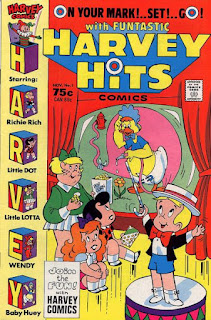
Harvey went on a long hiatus in 1982 (their last issues cover-dated Dec. 1982) and wouldn't re-emerge until Richie Rich #219 (Oct. 1986), which I bought when it came out -- this time for me, not my sister.  Although I was glad to see Harvey Comics back, and had the awareness now that I ought to buy them (unlike back in 1982), for some reason I didn't.  By 1987, I was 16 years old and more interested in the edgier comics being done (like Watchmen, whose first two issues I bought in one purchase at a local comics shop, around the same time that I bought Richie Rich #219).  Harvey continued to publish new comics into the early 1990s, including my particular favorites Little Dot and Little Lotta, although many of them consisted of reprints of older material (not that I would have minded).  Surely I would have bought a copy of HARVEY HITS COMICS #1 (Nov. 1986) if I had seen it on the stands, right?  Well, it's hard to say.  This was at the height of DC's revamping of their entire line following the events of Crisis on Infinite Earths, and thus following many of the new DC titles (including ones I had never bought before, like Wonder Woman) would dominate my attention and pocket money.  In retrospect, I think I would have been better off buying every issue that Harvey was putting out in the late 1980s, since buying the post-Crisis DC titles eventually became a joyless exercise.

One of my comics-buying regrets is that DC cancelled many of their "mystery" anthology titles just a year or two before I became interested in such comics, and thus I was not able to buy them new off the stands.  Between 1979 and 1982, the majority of comics that I bought were superhero comics, mainly ones by Marvel, but in 1983 I began to grow bored with Marvel and began branching out and trying different genres and publishers.  The first "independent" comic that I ever bought was Mighty Crusaders #3 (July 1983), soon followed by Black Hood #2 and Shield #2 (both Aug. 1983), published by Archie's direct-sale imprint Red Circle (more about that later).  I also began buying DC's All-Star Squadron regularly with #25 (Sept. 1983), the second DC series that I was buying (after New Teen Titans).  I was becoming nostalgic about the past, beginning to listen to old-time radio shows and reading about comics history (outside of Stan Lee's Marvel books on the subject), and All-Star Squadron's 1940s setting appealed to me for that reason.  Plus it had terrific art by someone that wasn't drawing for Marvel (Jerry Ordway), making me realize what I'd been missing by being so Marvel-focused for so long.  I was also buying 1970s reprints of old 1950s Marvel horror comics in the cheap bins, where I also found 1970s Charlton ghost comics, and my tastes were expanding beyond superheroes.  

Unfortunately, by the time that change in my tastes occurred in mid-to-late 1983, DC had already cancelled most of their "mystery" anthology titles, preventing me from buying them new off the shelves.  The last issue of Secrets of Haunted House was #46 (March 1982).  Ghosts #112 and The Unexpected #222 (both cover-dated May 1982) were the last issues of those long-running titles.  The war series The Unknown Soldier ended with #268 (Oct. 1982) and Weird War Tales (a particular favorite of mine, when I found them later in the discount bins, in the 1990s) ended with #124 (June 1983).  And finally, THE HOUSE OF MYSTERY #321 (Oct. 1983) was the final issue of that series, coming out only a month after I had bought All-Star Squadron for the first time.  I was just beginning to buy more DCs, but the number of series that I might have bought was being cancelled before I knew I'd want to buy them. 

DC was still publishing the western series Jonah Hex (ending with #92, Aug. 1985) and war comic Sgt. Rock (which lasted until #422, July 1988), but curiously I never bought either series new.  I did buy a few issues of G. I. Combat off the spinner rack: #267 & 268 (July & Aug. 1984), #277 (May 1985), #280 (Nov. 1985) and possibly #284 (July 1986).  The final issue was #288 (March 1987).  I was inclined to like G. I. Combat because it was an anthology series (providing more variety) but unfortunately it was dominated by the Haunted Tank feature, of which I was not particularly a fan.  It was great to be able to buy a brand-new war anthology comic, though, like the kind that had existed for decades before publishers catered more to the interests of superhero fandom.  I think I suspected even then that G. I. Combat was not likely to last long, given that DC had already cancelled their other anthology comics.

The number of DC comics that I failed to purchase, notice or appreciate in the early 1980s, during my pre-teen days devoted to Marvel, is too numerous to list here.  In some instances, as with the above-mentioned mystery titles, I was just a year or two too late in discovering them.  For example, one of my favorite DC characters is Superboy, and I have a fondness for his pre-Crisis adventures in Smallville, my interest prompted by somehow acquiring the 1980 Superboy Spectacular one-shot that reprinted many 1960s George Papp-drawn stories.  I think I had acquired that issue by 1983, but it didn't cause me to pick up the NEW ADVENTURES OF SUPERBOY series that was still being published at that time.  Shown here is the splash page of the final issue, #54 (June 1984) which demonstrates how it was still being produced in an appealing old-time style, with pencils by the great Kurt Schaffenberger (whose art I wouldn't appreciate until a year later, when I began buying Action Comics regularly, before the Byrne revamp took most of the innocent fun out of the comics).  The character would never be this good again, as far as I'm concerned, but I had no knowledge of that at the time.  (I actually never bought a Superboy comic new off the stands until 1998, when I added the modern series to my pull list.)

In 1983, I began buying 1970s Charlton ghost comics that I found in a local comic shop's "5 for $1.00" boxes.  I had been ignoring the "new" (all-reprint) Charlton comics on the spinner rack at the local 7-11, etc., but in late 1983 I finally began buying them.  My earliest purchases were Ghost Manor #72, Haunted #71 and Scary Tales #42 -- all cover-dated January 1984.  Charlton was also publishing a line of war comics, and the first that I bought was Battlefield Action #85 (Feb. 1984) and Fightin' Marines #173 (March 1984) -- which were the first war comics that I ever bought, period.  I was soon
 buying practically every "new" Charlton comic I saw on the stands, but even I missed some of them.  For example, Charlton's western comic GUNFIGHTERS was still being published at this time, but I never saw it in my area.  The final issue, #85 (July 1984), mentioned on the cover that it was reprinting work by Simon & Kirby -- so I know that if I had seen it, I definitely would have bought that.  No such luck.  (And I still don't have that issue.)

I was buying every ghost series Charlton published, but somehow never bought a copy of BEYOND THE GRAVE new off the stands.  I have a vague memory of seeing a copy on the spinner rack at a 7-11 far from my usual store, but not buying it for some reason.  I missed my chance, and the final issue was #17 (Oct. 1984) -- another comic that I still don't have.

In the summer of 1984, Charlton began to cancel their long-running comics.  For many years I thought the final issue of GHOSTLY TALES was #168, because I had been buying every issue since #165 and never saw one on the stands after #168.  Years later, when looking at a comics index, I was surprised to learn that the final issue was #169, which I never saw (and still don't have).  I'm sure that if I had seen it, I would have bought it, due to its eye-catching Mike Zeck cover.  I did buy the final issues of Ghost Manor, Haunted and Scary Tales, however -- although I did not realize it until a few months later, of course, when no further issues appeared.

I have a memory of debating whether I ought to buy Fightin' Army #172 (Nov. 1984) when I saw it on the spinner rack, since it consisted of a full-length story and I was more interested in the variety offered by the multi-story anthology format.  But being a Charlton fan, I bought the issue without knowing that it would be the last issue of the series to be published.  Had I known that, my decision to buy it would have been a lot easier.  

Charlton published a few one-shot "funny animal" comics that summer, and for years I thought I had bought both of them: Funny Animals #1 (Sept. 1984) and Zoo Funnies #1 (Dec. 1984).  Once again, it wasn't until years later, when perusing a comics index that I learned that I had missed two of them: ATOMIC MOUSE #1 (Dec. 1984) and FUNNY ANIMALS #2 (Nov. 1984).  There's no way that I would have passed them by if I had seen them on the spinner rack back then.  These were among the last comics that Charlton published in 1984 before going on hiatus for nearly a year. (I finally bought Atomic Mouse #1 a couple decades later at a comic shop, but still don't have Funny Animals #2.)  

In the summer of 1985 (beginning with issues cover-dated Sept. 1985), Charlton briefly revived their comics line, and I bought all of them that I saw on the stands.  Of the first four with September cover dates, I bought all four new off the racks.  Of the eight issues with October cover dates, I bought six of them when new, missing only the two war titles. Of the four issues with November cover dates, I bought none of them. (One of those issues was DR. GRAVES #74, which I would have been likely to buy if I had actually seen it on the stands. My guess is that the November issues didn't make it onto the spinner racks in my area for some reason, or at least not long enough for me to see them.)  

Charlton put out six issues with December 1985 cover-dates.  I have all of them, and I know that I had bought at least two of them new (Charlton Action #12 and Iron Corporal #24).  I think I may have got the rest, including Mysterious Traveler #15, as back issues at a local comics shop sometime later.  

Charlton put out six issues with January 1986 cover-dates.  Again, I have all of them now, although I'm unsure which ones I bought new or later on.  I do think I bought at least two of them new, and the rest later.      

Charlton put out only three issues with February 1986 cover-dates, and these were the last comic books that Charlton ever published.  They are Iron Corporal #25, Prof. Coffin #21, and Punchy and the Black Crow #12.  That last one I definitely never saw, and never saw later either.  I was pretty deliberate in buying Charlton comics at the time, recognizing by this time that the company could perhaps go out of business (which they eventually did) and that any comic of theirs that I saw could be its last.

With Archie Comics, it was a different story.  Some of their titles had been around since the Golden Age, and it never occurred to me that a comic like Jughead would get cancelled.  The comics they published that didn't involve the Archie gang, however, seemed to be in a constant state of change during the period that I paid attention to them (mainly, 1983 to 1985). Their direct-sale Red Circle superhero line morphed into a newsstand-distributed Archie Adventure line beginning with issues cover-dated February 1984.  This was fine by me, since it meant that I could now buy them at local convenience stores and bookstores rather than at comics shops (which were few and far between).   

By the end of 1984, most of the Archie Adventure titles had been cancelled, and I bought some of these last issues -- like Steel Sterling #7 (July 1984), The Fly #9 and The Original Shield #4 (both Oct. 1984) -- without realizing that there would be no subsequent issues of those series.  I avoided the Mantech series that was introduced that year because it had a "kiddie toy" look, unlike the other Archie Adventure comics.  I had been buying Mighty Crusaders regularly, but after #9 (Sept. 1984), I didn't see it on the stands for a long time.  The next one I saw, #12 (June 1985), was now drawn in that "kiddie" style that I didn't like.  I bought it anyway, simply glad that the series was still being published.  I also bought #13 (Sept. 1985) which would be the last issue published.  Somehow I had missed #10 (Dec. 1984) and #11 (March 1985) when they originally came out.  MIGHTY CRUSADERS #11 had introduced the new "kiddie" look, and I'm still missing that issue from my collection, all these years later. 

In 1984, I was not only buying Archie's superhero comics, but their humor comics as well.  As I wrote about in a previous blog post, I'd read in Comics Scene #11 that Bob Bolling would be taking over as writer/artist of ARCHIE AND ME with #141 (Oct. 1983).  Unfortunately I didn't see that issue (and didn't actually buy it until 2022) but I did buy
 Archie and Me #142 (Dec. 1983) when I saw it on the spinner rack at the local Lawson's store.  This was the first Archie humor comic that I ever bought new; I enjoyed it a lot and began buying more of the Archie line.  I bought Archie and Me #143 (Feb. 1984), but then missed #144 (April 1984), #145 (June 1984) and #146 (Aug. 1984) -- presumably because I never saw them.  I did buy #147 through #153, missing only #149 (Feb. 1985).  But I didn't buy the series after #153, perhaps because Bob Bolling's contributions had become less frequent.  The GCD entry for #152 says, "This is the last story from Bob Bolling's memorable run as writer-artist on Archie and Me (though he would draw, but not write, some later stories for the title)." Bolling actually had work in every issue after #152, except for #153 (the last one I bought new) which had no Bolling work inside.  I guess I figured that Bolling had left, and so I left as well, not buying the series again and evidently not even looking inside any new issues that I saw to see if he had returned.  As it happens, Archie and Me #161 (Feb. 1987) was the last issue of the series -- although it would become one of the rotating features in the Archie Giant Series Magazine (more on that below).  Had I known that the comic would be cancelled soon, I might have kept buying it after #153, to see it through to the end. 

Archie and Me
#142 was the only Archie humor comic with a 1983 cover-date that I bought new.  I bought two issues with January 1984 cover-dates when they came out: Archie's Pals n' Gals #167 and Life with Archie #240.  I enjoyed those issues, too, and this made me realize that non-Bolling Archie humor comics were worth checking out.  I found them to be a breath of fresh air after having basically gorged myself on Marvel superhero comics for the previous five years.  The Archie humor comics that I bought with February 1984 cover-dates were Archie and Me #143 and Archie at Riverdale High #95.  I don't recall seeing KATY KEENE SPECIAL #2 (the first newsstand issue after the direct-sale special #1) at the time.  The first issue of that series I bought was #4 (June 1984) and I recall being surprised to see it at a local bookstore, so I suspect I hadn't seen #2 or #3 at all.  I had seen #1 at a local comics shop in 1983, but didn't buy it because I overheard the store owner offering to give this "girl's comic" (Red Circle's Katy Keene Special #1) to a customer's daughter for free, and I would have felt foolish buying a copy from him!

Of the March 1984 Archie humor comics, I bought Archie #328 and Pep #393. Of the April 1984 issues, I bought only Jughead #333. Of the May 1984 issues, I bought Archie #329 and Everything's Archie #111.  As I look through the gallery of covers showing what came out each month, I'm intrigued by what I didn't buy each month.  Why did I buy (and enjoy) Pep #393, but then not buy another issue of Pep until #401 (July 1985)?  Would I have been more deliberate in collecting the series if I had known that #411 (March 1987) would be the last issue of this series that started in 1940?  Another example is Archie's T.V. Laugh-Out, an anthology series that featured Josie and Sabrina backup tales in addition to The Archies lead stories.  I bought only one issue of this series when it was new: #101 (June 1985).  It wasn't until years later, looking at comics indexes, that I noticed the series ended shortly after, with #105 (Feb. 1986).  I collect the series now, and wish that I had been more dedicated to buying it each issue, the way I tended to be towards Marvel and DC superhero series.  It's a similar story with Archie at Riverdale High: I had bought #95, 97, 102 & 103 when they came out; #113 (Feb. 1987) was the final issue.  It was the kind of series that I had assumed would always be around.

As with the DC "mystery" titles mentioned earlier, Archie had already cancelled many series that I might have bought later on when my buying habits had expanded.  So, I may have seen them on the stands at the time, but I had ignored them because they weren't published by Marvel.  For example, Archie had published a humor anthology series called Mad House Comics that I'm sure I would have bought if it had been published in 1984 or 1985.  Unfortunately, the final issue, #130, was cover-dated Oct. 1982 -- too early for me.  The final issues of Josie and the Pussycats (#106) and That Wilkin Boy (#52) were also cover-dated Oct. 1982.  The fact that these three series ended the same month appears to suggest a purge of non-Archie-gang titles -- offering less variety in the line. Sabrina the Teen-Age Witch's series ended a few months later, with #77 (Jan. 1983), followed by the cancellation of Little Archie with #180 (Feb. 1983).  The good news, though, is that Archie continued to publish Little Archie, Josie and Sabrina issues as part of their aforementioned Archie Giant Series Magazine title.  This series came out on an irregular basis (as will be seen below) and featured a different character or series per issue.   

The first ARCHIE GIANT SERIES MAGAZINE (AGSM) issue I bought was #538 (Aug. 1984) which focused on Little Archie.  Two more issues, #539 (Betty and Veronica Summer Fun) and #540 (Josie and the Pussycats) came out the same month, but I didn't buy them.  The next month #541 (Betty and Veronica Spectacular) and #542 (The World of Jughead) came out, but I didn't get those either.  Nor did I buy #543 (The World of Archie) or #544 (Sabrina) when they came out the month after that.  The latter issue was written and drawn by Bob Bolling, so surely I would have bought it if I had seen it.  I also didn't buy #545 (Jan. 1985), which focused on Little Archie, but I did buy all but four of the next 11 issues, missing only #549 (Little Archie by Bob Bolling), #551 (Josie), #553 (World of Jughead) and #554 (World of Archie).  So even when I had a chance to buy a new Josie or Sabrina comic, in this revolving series, I failed to do so.  (In fact, I never bought a new Josie or Sabrina comic during the 1980s.)  Evidently by 1986 I had lost interest in Archie's humor comics, as #556 (Jan. 1986) was the last AGSM comic that I bought, despite the variety that it offered.  Eventually some of the cancelled series like Pep and Archie and Me were added to the AGSM rotation, but if I noticed at the time then I long ago forgot it.  The final issue of the series was #632 (July 1992).  

Curiously, the only BETTY AND VERONICA comics that I bought during the 1980s were the ones featured in AGSM.  I can only conclude that I simply never saw the regular B&V series on the stands in 1984 or 1985, when I was actively buying new Archie comics. As it happens, their regular series ended with #347 (April 1987) and then returned a few months later with a new #1 (June 1987). I'm pretty sure I didn't know about this at the time, or else I would have bought it. (I was buying all those new DC #1's at the time, after all!) What's crazy to me, looking back, is that Jughead also got renumbered and I didn't know that either. I bought Jughead #333 (April 1984), #334 (June 1984), #336 (Oct. 1984) and #341 (Aug. 1985) when they came out. It turns out that #352 (June 1987) was the last issue of this series that had begun in 1949. Somehow I didn't notice Jughead #1 (Aug. 1987) when it came out, the first issue of a renumbered series that ran until 2012.  

It's possible that I simply didn't notice these changes on the spinner racks as they were occurring, and what comics industry news that I was receiving gave little notice to Archie comics.  For example, given my interest in long-running anthology comics, one might assume that I bought at least one issue of Laugh in either 1984 or 1985.  The series began in 1942 as a Hangman comic, then changed its name to Black Hood Comics in 1943.  In 1946, with issue #20, it became Laugh Comics (later simply Laugh), reflecting MLJ's switch from superheroes to humor due to the popularity of Archie Andrews.  I bought only one issue of Laugh new: #393 (Feb. 1986).  I assume that I never bought more because I never saw them.  I only recently learned that #400 (April 1987) was the final issue.  But the series didn't end there -- it was renumbered.  I certainly never saw LAUGH #1 (June 1987) or else I would have bought it.  The new series ran until #29 (Aug. 1991).  Incidentally, there was also a Laugh Comics Digest that lasted from 1974 to 2005.  I bought #55 (Nov. 1984) and #58 (May 1985) when they came out.  

In 1984, when Marvel's Secret Wars maxi-series began, I avoided it, even though I had greatly enjoyed Mike Zeck's artwork on Captain America.  To my mind (and I feel the same way now as I did then), Zeck and inker John Beatty were wasted on the bland Secret Wars.  So, when DC published CRISIS ON INFINITE EARTHS #1 (April 1985), I also ignored it despite my love for the artwork of George Perez.  As can be seen above, my tastes at the time were leaning in the opposite direction, towards smaller stories aimed at a general audience, not big "events" serving fandom.  I managed to hold out until I saw Crisis #7 (Oct. 1985) featuring the death of Supergirl.  I set aside my prejudices and bought the issue, and didn't miss an issue of Crisis after that. DC was on fire and I was eager to watch the changes blazing across their line.  I think this explains why I stopped buying Archie comics after 1985, since DC was a more exciting alternative to mediocre Marvel.  

In 1985, I bought two of the earliest Gladstone releases: Walt Disney's Disneyland Birthday Party and Walt Disney's Uncle Scrooge Goes to Disneyland.  Both issues were digest-size, and I bought them simply because of the novelty of seeing them on the stands.  Western Publishing (Gold Key, later Whitman) had been publishing Disney comics prior to this, but I have no memory of seeing them among the other new comics in the late 1970s or early 1980s.  I'm not really a Disney fan, so it's possible they were there and I just didn't notice them.  At any rate, Western stopped publishing comics in 1984, and until these Gladstone digests appeared in 1985 there were no new Disney comics to be found.  (In fact, these two digests consisted of reprinted material.)  The following year, Gladstone revived Western's old Disney comics, continuing their original numbering, in standard comicbook format with no ads.  The comics were available on newsstands, but for some reason I didn't buy them as I had those two 1985 digests.  DONALD DUCK #246 (Oct. 1986) was the first issue of the revived series, but I didn't buy a copy until #268 (Nov. 1988), two years later.  Why did I wait so long to buy one?  I have no idea.  It may be that the Disney characters were of less interest to me, despite my respect for the quality of the craftsmanship of the illustrators.  Looking back now, this period was a great time for children's comics, with offerings from Gladstone, Archie, Harvey and even Marvel's Star Comics line (which ran from 1985 to 1988).    

As noted earlier, I rarely bought new comics at comics shops in the 1980s, especially prior to 1985.  Even many of the Marvel and DC direct-sale series like Marvel Fanfare or Frank Miller's Dark Knight weren't purchased by me until years later, not new off the shelf.  This was also true of many of the comics published by First, Eclipse, Fantagraphics, Renegade, and so on.  By the mid-to-late 1980s, there were so many companies putting out comics that I'm often surprised by some indie comic that I had no idea existed until finding it decades later in a dollar box (like, for example, the WEIRD ROMANCE one-shot from 1988 shown here).  Eclipse and Renegade were probably my favorite indie publishers of the 1980s, but I actually only bought a handful of their titles brand-new.  Sometimes I would buy a few month's worth of new-ish titles all in one shot during a visit to the local comics shop.  Or obtained issues that were a year or two old through Mile High Comics' mail order service.  So it was a bit different than the experience of visiting the spinner rack each week at a local drugstore, hoping that the new issue of a favorite series had arrived.

In 1997, after having taken a break from buying new comics for most of the 1990s, I began pre-ordering comics via Diamond's Previews catalog through a comics shop that was within a 20-minute walking distance of my home.  Had that been available to me in the 1980s, my comics-buying experience might have been very different.  On the other hand, being forced to look for alternatives to Marvel on the newsstand (rather than the wider direct-sale selection) caused me to buy some comics that I might otherwise have not tried.  So for that, I guess, I'm grateful -- despite all the comics I missed along the way.  

Wednesday, February 16, 2022

My History of Buying Comics: 1983 - 2013

Here's a post I wrote in 2004 on a comics message board about what I perceived as a lack of variety in the current comics scene, compared to the old days.  From 1997 to 2013, I was regularly buying new comics every month, which is no longer the case.  At the end of the post I have added a 2022 update about the fate of some of the comics that I was buying in 2004.

_______________________________________

Since I'm the one who began this thread, perhaps it's a little obvious that I think there's less variety in comics than there used to be.  

Ever since 1997, I've been getting most of my new comics by advance-ordering them through the Previews catalog.  For the first two years, this meant going page by page through the Previews catalog looking for stuff to order.  Nowadays, I look up the listings online at Diamond's and Westfield's websites.

For most of the 1990s, I looked down on new comics and didn't buy them.  I'd loved the 1980s era and became turned off by what I viewed as the increasing commercialization and standardization of the mainstream comics by the end of the decade.  To use one prominent example, the way that DC tried to emulate Marvel after "Crisis," abandoning their former light-heartedly imaginative style where, say, "Sons of Superman and Batman" stories (1970s World's Finest Comics) were possible.  Or the way that DC dropped their mystery, war, and western lines to focus increasingly on the fan market (particularly superhero fans, and Marvel fans) who bought their comics at comics shops, abandoning the non-fan general audience who bought their comics at 7-11s and drugstores.

Although I'm as much of a Marvel superhero fan as anyone else, and remain so, by 1983 (when I was 13), I began to grow weary of Marvel's formula of 22 pages of superhero action produced by assembly-line.  I began looking beyond them.  I started buying Archie comics, which at the time was not only publishing Archie humor comics, but also superheroes with the Red Circle/Archie Adventure line (e.g., Ditko's The Fly, Dick Ayers' The Original Shield, etc.).  For a short while during 1985, Katy Keene was billed as an Archie Romance Comic and was drawn in a serious style like a comics version of a soap opera, or like Dazzler without the superheroics, before reverting back to a more cartoony-drawn fashion-plate comic.  They were also still publishing anthology comics like Pep and Laugh where you'd find not only a story or two about the Archie gang but also a story about a less-familiar character, like the comedic sci-fi serial "Marvelous Maureen."  I currently buy most of Archie's new comics today, but even I have to admit that there's less variety there than what was coming out of the company in the mid-Eighties when I started buying them.

I also began buying Charlton in 1984, shortly before that company's demise.  They published a slew of ghost-story comics (Ghost Manor, Ghostly Tales, Beyond the Grave, etc.) and war comics (Attack, Battlefield Action, Fightin' Marines, Fightin' Army, Fightin' Navy, etc) and a western comic called Gunfighters.  In the early 1980s, Charlton attempted a romance-comic revival with their Soap Opera comics.  By 1984-85, Charlton also began publishing humor comics again like Atomic Mouse.  (This was during the time in the 1980s when funny animals became popular again, with DC publishing Captain Carrot and Archie (and later WaRP) publishing Thunder Bunny, who incidentally had a story in Pep in 1984, too.)  

The early 1980s saw the demise of the Whitman and Harvey lines of comics, but the Harvey comics returned later in the 1980s before disappearing (forever?) in the mid-1990s.  Warren ended their horror magazine line in the early 1980s, and Marvel also cut back, to the point that it's unimaginable that the company today would attempt something like Epic Illustrated, a format which at one time appeared to be the future of comics.

At the same time, there was exploding growth in the 1980s of the independent ("alternate" or "alternative") comics scene.  This encompassed everything from Marvel-DC wannabes (albeit with usually a concession to creator-copyright of the material) like First, Eclipse, Now, and Dark Horse, to more artistic companies like Fantagraphics, Vortex, Kitchen Sink, underground style comics like Weirdo, anthologies like Art Spiegelman's RAW, and small-press and self-published titles like American Splendor, Cerebus, Elfquest, TMNT, and so on.  Pacific and then Eclipse stepped into the void left by the demise of Warren, DC, and Charlton's mystery lines by coming up with new titles like Twisted Tales (later Tales of Terror) as well as 1950s horror reprints in the mini-series Seduction of the Innocent.  

Romance comics were reprinted by Eclipse (True Love #1-2) and Fantagraphics (Untamed Love) and Eternity, while Renegade attempted new romance comics with Renegade Romance #1-2.  (Since 2000, thankfully, there have been three other romance reprint comics that I know of: DC reprinting two hard-to-find romance issues and Fantagraphics' insightful Romance Without Tears TPB which was released a few weeks ago.)  If you look at the bookshelves of any drugstore, you'll notice that romance novels occupy the largest amount of space on the shelf, and yet comics have abandoned this market.  It wasn't always so, and even Marvel used to publish romance comics into the early 1970s.  Considering the amount of pages published by the company, and the caliber of talent involved (sometimes the same talents like Lee & Kirby who were doing the superhero mags), it's surprising that this romance work has not been reprinted at all.

In the 1980s, the worst comics shop in my area, one that carried mostly mainstream titles, at least still carried Cerebus also.  The only reason that I've been able to buy Cerebus there in recent years is because I specifically advance-ordered it every month.  They've devoted shelf space to CrossGen today, just as they devoted some space to the more popular Eclipse and First titles in the 1980s, companies whose comics look as though they may appeal to Marvel and DC superhero fans even if technically the comic is not about superheroes (they just look that way).  

During the 1980s, I learned about innovative independents like Love and Rockets and Yummy Fur by simply buying them off the shelf of one of the better comics shops in my area (a shop which had closed its doors by 1991).  I first heard about Yummy Fur when I read a letter in CBG (also available at the shop) where a reader praised it and wished more people were reading it.  Back then, lots of indies were flooding many comics shops (creating the B&W boom which wiped out a few publishers in the process).  Stuff which looked like it had been made at Kinko's was finding its way onto the shelves, even faster if it parodied a popular comic.  I remember buying a copy of the amateurish Jontar just because I was so surprised to see something so amateurish on the shelf.  (The majors had also looked at developing amateur talent, with DC having a series called New Talent Showcase in the early 1980s for that purpose.  Back-up stories, once prevalent in DC comics, allowing them to use many characters in the same comic, making for more variety, and also allowing newer untested talent a try-out without having a whole comic riding on the outcome.)

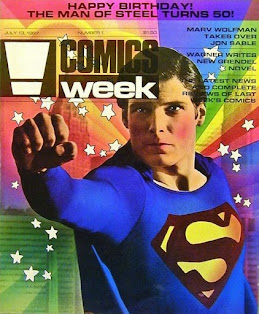
Also bought off the shelf at that shop in the 1980s: a copy of Gene Kehoe's excellent It's a Fanzine, where you could read reviews and articles by fellow fans (including the famous T.M. Maple).  Ditkomania was publishing an original comics serial, "The Last Tim Boo Ba Story," in addition to its fan-written articles.  (Today's internet is no substitute for this wonderful expression of fan creativity.)  Such zines were part of a community of fans like UFO (the United Fanzine Organization); I only know the names, from a UFO Checklist, of such zines as Slam Bang, Future Fanzine, Heroic, and others. For those seeking more professional-looking zines, Fantagraphics published not only The Comics Journal (as they do still, although to much less visibility) but Amazing Heroes as well.  Other comics fan mags included Comics Feature, Comics Scene, Comics Interview, and the short-lived Comics Collector and ComicsWeek.  Some of these publications were available in regular bookstores at the time, unlike most of today's counterparts (Comic Book Marketplace, Alter Ego, etc).  

Strange as it may seem to those who were there, an alternative comic like Love and Rockets was more prominent in 1989 than it is today in 2004.  At the time, L&R was published more regularly (and at magazine-size) and could sometimes be found in ordinary bookstores.  I remember at the time buying a copy of L&R #29 in the bookstore of my small hometown.  (Circa 1996, I also bought a copy of DC's Weird magazine there.)  Ads for L&R #5 had appeared on newsstands in 1985 when Fantagraphics placed an ad in all of Charlton's comicbooks for a month.  The new volume of L&R, which is comics-sized (although more expensive than the mag was) has not had such mainstream exposure (unless you want to count the cover of the new Indigo Girls CD) and who knows how people are discovering it outside of comics shops.

The first comic that I advance-ordered through Previews in 1997 was Totally Horses Magazine, a new color comics magazine devoted to the subject of horses.  Not only were their gag strips about horses, but serious dramatic ones as well.  Each issue reprinted a Black Fury story from the 1950s, a Charlton series about a heroic horse.  Such "animal comics" would seem to be a natural for a young audience, and indeed older eras produced their share of such comics, as in the case of DC's Rex the Wonder Dog.  Today, however, DC seems embarassed to even feature Krypto cameos, let alone solo Krypto back-up stories (something which could be found in Superboy comics as late as 1982).  Even Marvel had comics stories about animals in the old days -- for example Kid Colt Outlaw #10, published in 1950, which has a short non-Kid Colt tale about animals in the wild, with not a human in sight.  In the 1980s, Fantagraphics published 50 issues of Critters, from which Dark Horse's Usagi Yojimbo is still running today.  

Unfortunately, Totally Horses Magazine was short-lived in today's market.  If I want to read comics about horses, I must (as I did last month) purchase comics of the past such as Black Fury.  I wish it were otherwise.  I think the market would be richer, more healthy, if it had more variety like this.  
One of the next titles in 1997 that I decided to follow was The Kents.  This seemed to illustrate practically the only way that a non-superhero genre like the Western (once a staple of the medium) could be published by a major company like DC, by tying it into one of the company's superhero properties.  Thus, we can get a police comic again, but unlike Police Action or Lady Cop (1970s), only if the comic is about Gotham City's police department.  And teen girls can only be aimed at by Marvel if it has to do with Spider-Man (e.g., Trouble and the Mary Jane book).

One company that was soliciting product in the Previews catalog in 1997 looked so interesting to me that I think I advance-ordered every single title they offered.  This was Pyramid Comics, who promised an inexpensively-priced line of comics such as True Romance, Triple Threat, and The Space Giants.  They also soon offered a line of reprint titles under the Hyper-X Classics imprint, including Great Western, Alarming Tales, Boys Ranch, Western Tales, Thrills of Tomorrow and Race for the Moon among others.  Cover images were shown for many of these comics in the catalog, and one waited in vain for the solicited titles.  Four issues of True Romance had been solicited, but none ever appeared in shops, the entire company's output having been cancelled prior to publication.

Ah well, there was still ACG/Avalon reprinting old Charlton and ACG comics from the 1960s-70s, and A List Comics reprinting Golden-Age titles like Jungle Comics, and Gemstone reprinting EC.  (Even DC was reprinting EC at this point, the entire 1950s run of the comicbook-size MAD.)  By 2000, all of these efforts were pretty much over.  AC Comics is still reprinting old comics in semi-affordable format, although concentrating more on superhero reprints these days, and less than ever on western reprints (unlike the situation at AC, say, fifteen years ago when they were devoting entire comics to Roy Rogers and other cowboy stars).    

While Dark Horse is still publishing some worthwhile titles, to my mind they've gone more into the licensed properties business (Star Wars comics, etc.) than what seemed their original intent.  Can anyone say that they honestly prefer Dark Horse's current offerings to what the company offered in the 1990s?     

So, what does this grumpy old fan buy today?

I buy most of Archie's "pamphlet" comics (not the reprints).  I love anthologies for the multi-story format (i.e., for the variety) and Archie is still providing that, one of the few to still aim at general readers.  Of course, they no longer have a Red Circle line, nor even That Wilkin Boy or Lil' Jinx, but it's enough like the old-time comics to keep me happily buying them.

I've also begun buying the "pamphlet" Gemstone Disney titles since they started up again, although not the more expensive books.  Again, I like the multi-story anthology format that they have every issue.  Reminds me of the comics of old.

I buy a few CrossGen titles such as Sojourn, Kiss Kiss Bang Bang, Brath, and El Cazador.  I advance-ordered the latter series as soon as I heard they were doing a pirate comic, since of course I support such exploration in those waters (no pun intended), barely charted in comics except most notably by EC's Piracy in 1955.  Sojourn makes me feel like I'm reading a 1980s Eclipse or First fantasy/adventure-hero comic.  Ruse was the first non-Perez CrossGen title that I added to my pull list and I was disappointed when it was cancelled.  That was the kind of non-superhero comic that I'd like to see more of, and it's Victorian style locale appealed greatly to a nostalgic like myself.

And I buy a few mainstream titles by favorite creators, or starring favorite characters.  And I buy some indie comics like Love & Rockets, although I try to avoid what appears to me to be the more amateurish kind that I see around (for example, numerous pages in the annual Small Press Expo sampler books).  And I also buy a lot of the modern magazines about comics such as CBM, CBA, JKC, A/E, and so on.

But what do I do if I want to read a comic about cars?  The logical solution seems to me to be to delve in the back issue bins, looking for Charlton comics like Drag N' Wheels, Grand Prix, and World of Wheels, or the long-running humor mag CARtoons.  (If one can find any in back issue boxes, that is!)
What if I want to read a sports comic?  DC used to publish Champion Sports in the 1970s, and there were other old comics on the subject in the dim past, but today perhaps the only comics about so popular a topic are sports manga (if they are even translated yet).  (However, a recent Gemstone Disney comic did feature a fun soccer story.)

I wish there was more variety in comics today.  I'd have more comics to buy and read.

____________________________________________

2022 POST-SCRIPT:  

Between 1997 and 2013, I had a "pull list" at a local comics shop, buying and pre-ordering new comic books every single month.  When I wrote the above post in 2004, I was buying Gemstone's Donald Duck & Friends and Mickey Mouse & Friends every month, as well as Archie's Jughead, Betty & Veronica, Betty & Veronica Spectacular, Sabrina (during its manga phase) and Archie & Friends.  Unfortunately Gemstone cancelled both Disney titles in 2006, and I dropped the Archie titles from my pull list in either 2005 or 2006.  The CrossGen titles that I praised in my post above were all cancelled in 2004 when the company went out of business.  I think the last Archie comic that I bought new was Betty & Veronica #258 (April 2012) which I bought at a Barnes & Noble bookstore because I noticed that the issue guest-starred Lady Gaga.

I was even buying the occasional X-Men comic, when it was drawn by an artist I liked such as Alan Davis.  I had taken a break from buying Captain America during the "Marvel Knights" era at this time, but would soon return the title to my pull list when Ed Brubaker took over as writer at the end of the year.  I also added Daredevil in 2006, which Brubaker also wrote, to my monthly pull at that time.  And I had been buying Avengers every month since 1997, finally dropping it for good in 2007 during writer Brian Michael Bendis' run.  I eventually dropped both DD and Cap from my pull lists in 2013.  The last DC series I had on my pull list was Booster Gold, which I dropped in 2010 after Dan Jurgens left the series.

I still bought the occasional new comic book after 2013, but not regularly.  I had bought and enjoyed John Byrne's various series for IDW around this time, but new Byrne comics appeared to have disappeared after 2014.   IDW's Popeye series in 2012 and 2013 was one of my favorite new comics, but it ended after only 12 issues.  I also bought a few issues of IDW's reprint series Haunted Horror in 2012 and 2013, but didn't keep up with it and don't recall seeing it on the shelves after that, although it ran until 2018.  

I think one of the things that kept me from continuing to buy new comics regularly after 2013 was their increased cost.  In early 2005, a current issue of New Avengers was only $2.25 at comics shops. (The cover price was higher on newsstand editions.)  The price was raised to $2.50 later that year, and then jumped again to $2.99 in 2006.  As $2.99 (and even $3.99) became the norm, I found myself cutting back, and wondering if what I was buying was worth the expense.  Later on when I wanted to trim my collection, I found that many of these modern comics weren't going to sell for nearly what I had paid for them when new.  It felt like throwing money away -- money that would be better spent on back issues if I was going to be spending $3 or $4 per comic.  

Another factor in my dwindling interest in new comics was the changing creative teams and constant renumbering.  While a new #1 could cause me to try out a series I wasn't buying before, it also created a jumping-off point for a series that I had been buying but was no longer enjoying as much as I had in the past.  There was no need to keep buying the series for the sake of "keeping the collection going" when "my" run had ended and been renumbered.  There were fewer familiar names among many of the artists and writers working on the books, too, and even some of my former favorites were no longer doing material that I felt was as appealing as they had done before.  And once one gets out of the habit of going to the comics shop every week or two to buy new comics, and finds some other way to spend one's money, then it's a little harder to get excited about starting up the habit again.  

There's also a sense that the glory days of many of today's comics are firmly in the past, and that any new installments are not worth one's time, let alone one's money.  Will a new Spider-Man comic really be better than all of the classic Spider-Man comics of previous decades?  Of course, when I was buying Ed Brubaker's Daredevil every month, I knew that it was unlikely to be regarded as highly as Frank Miller's groundbreaking work on the series.  I enjoyed Brubaker's DD anyway, but admittedly I'm less inclined to reread them.  I enjoyed them in the moment, in the way that one follows a favorite new TV series, without pausing to consider its place in the pantheon of broadcasting.  

For the past few decades, the comics industry has been dominated by pointless "events" designed to excite readers with the illusion of radical change, but ultimately many of these events leave a bitter taste in the reader's mouth.  Even when they fulfill their promise of making permanent changes, often it seems like those changes ought never to have been made, ruining a character or comic that one had previously enjoyed.  I sometimes look at Marvel's print subscription page on their website, wondering if I ought to treat myself to a sub to a new series.  But then I recall how even as a teenager I had grown disillusioned with Marvel and had let my subscriptions lapse.  If I didn't like them all that much back then, why would I expect to like them today, when they are so much more corporate and slick now than they were before?   If I want to read some "new" comics that appeal to me more, my best bet would be to spend that money on old comics that I've not read before.  

Nonetheless, I am glad that comics are still being published today, although I am sad to see that there appears to be even less variety today than there was in 2004.  Archie digests are still available in supermarkets, but Archie no longer publishes the regular teen-humor comic books for which they were famous for decades.  (In more recent years, Archie's standard comics switched to a more "realistic" style.)  Marvel and DC have published some comics that dabble in traditional non-superhero genres, but always insert their superhero characters and their baffling universes into them, undermining the chance to reach a non-fan general reader in the way that, say, Charlton did.  There may be some new comics that I would like just as much as those of old, but it may be that their price-point keeps me from discovering them, or my disinterest in pre-ordering new comics sight-unseen makes me unaware of them.  And yet, somehow, in the past I was able to hear about new comics that I might enjoy without too much trouble.  If it's difficult to find the good new stuff today (even for a knowledgeable fan like myself), that in itself ought to be a cause for concern about the medium's survival in the years ahead.    

Wednesday, January 19, 2022

A Double-Edged Sword: Roy Thomas, Frank Thorne and Red Sonja

I originally wrote the following in August 2019 as a multi-post thread on an internet forum, but figured that I ought to preserve it here (with some minor revisions) as an entry on my blog.  I had been looking over my collection of 1970s Red Sonja comics, produced during the same period as Jack Kirby's return to Marvel (1975-1978) and noticed some interesting parallels to reader reaction in the letter pages, as well as matters related to the question of character creation. 

To start things off, below is the text page by Roy Thomas in MARVEL FEATURE #1 (Nov. 1975) which was the first "all Red Sonja" comic book. As Roy explains, the character first appeared in Conan #23 & 24 (Feb. & March 1973), loosely based on a Robert E. Howard character named Red Sonya.  The character next appeared (redesigned) in Savage Tales #3 (Feb. 1974), Savage Sword of Conan #1 (Aug. 1974), Conan #43, 44 & 48 (1974-75), and Kull And The Barbarians #2 & 3 (1975). Her very next appearance was in this Marvel Feature #1 issue which contained a new 8-page tale by Roy Thomas & Dick Giordano and a color reprint of the Savage Sword #1 story.  

In the text page, Thomas notes that future issues will be drawn by Frank Thorne ("a long-time pro making what amounts to his Marvel debut, will be doing his pen-and-ink thing").  You can click the image below and open it in a new tab to view it larger.


There was no text page in MARVEL FEATURE #2 (Jan. 1976). The credit box on the splash page lists Bruce Jones as writer, Frank Thorne as artist, Roy Thomas as Editor, and Robert E. Howard as Red Sonja's creator. No credit is given for the lettering or coloring (possibly by Thorne, as we will see ahead).

MARVEL FEATURE #3 (March 1976) has the same credits on the splash page, plus Petra Goldberg as colorist. The issue's lettercol concerns Sonja's appearance in Kull And The Barbarians #2.

MARVEL FEATURE #4 (May 1976) has the same credits as before, with the exception of "G. Roussos" listed as colorist. No letterer credit is given, although presumably it is Thorne who is only credited as "artist." This issue's story will be reprinted a year later in The Superhero Women by Stan Lee (more to come on that). Once again, there is no text page in this issue.

MARVEL FEATURE #5 (July 1976) has a credit box on the splash page that lists Jones as writer, Thorne as artist, D. Warfield as colorist and Thomas as editor (in that order). Instead of a text page this issue, there is a Sonja pin-up by Thorne. In a future issue, Thomas explains that the lettercol for this issue went missing, so the pin-up was printed instead.

MARVEL FEATURE #6 (Sept. 1976) has Roy Thomas as writer-editor, Frank Thorne as artist-letterer, George Roussos as colorist and Robert E. Howard as the characters' creator, credited that way (and in that order) on the splash page. This issue's lettercol (shown below) features the first reader responses to Frank Thorne's art, led off by reader Ralph Macchio criticizing Thorne's art as too detailed, while praising his layouts.  "What most disturbs me about Frank's art," Macchio writes, "is the way he seems to clutter each page with figures and lines that tend to tire the eye."

In reply, editor Roy Thomas says that Thorne's art has received a mixed response from readers and that (non-artist) Roy has been "working with him to develop Red Sonja artistically along certain lines as we go along."  


MARVEL FEATURE #7 (Nov. 1976) is the final issue of the series; two months later Red Sonja will receive her own series with a new #1. This issue guest-stars Conan. On the credit box, no letterer credit is given as Thorne is listed simply as "illustrator." Hugh Daley is the colorist. 

The lettercol has only two letters, one by Bob Rodi praising Thorne ("I think I'm in love. Not only with Sonja, but with Thorne. An incredible man!") and a letter by John Schuch criticizing Bruce Jones' Sonja scripts. (Jones' last Sonja script was in Marvel Feature #5.) In his response, Thomas alludes to the multiple hands involved in Sonja's creation: "more or less conceived by Robert E. Howard... then turned into a Hyborian-Age heroine by Roy in CONAN #24 (with some artistic help by Barry Smith, of course)." Roy agrees with the reader that some readers were "bothered by minor touches" in Bruce Jones' handling of Sonja.


I don't have RED SONJA #1 in my collection, but I do have the rest (#2 thru #15, with #15 being the final issue).  According to its GCD entry the issue had a letters page.  The splash page credits Ed Summer with the plot, with Roy Thomas and Clara Noto as the writers of the story.  Frank Thorne's contributions are listed second in the credits, as "art-color."  Of course, publisher Stan Lee's name is the most prominent (and first) name listed, "presenting" a comic that he likely had little personal involvement with.


I knew that Frank Thorne left the Red Sonja series at some point before it ended and was curious to see how all of this played out by looking through these issues. It was clear to me (and will become more clear going forward) that Frank Thorne was a "complete" creator who can do it all (writing, penciling, inking, lettering, coloring) and appeared to prefer doing it all, in the same way as an Alex Toth or in the same way as many independent creators. And yet here he was doing that (aside from the scripting) every other month, every issue, on a mainstream newsstand comic published by Marvel, which more often is run like an assembly-line. It's clear that Thorne became enthusiastic about a character he didn't own and hadn't created, and yet had become her biggest champion. Did Marvel readers, accustomed to the assembly-line approach that dilutes such individualistic expression, appreciate what Thorne was doing?

For years I assumed that Thorne was one of the young fan-favorite illustrators that first appeared in the late 1960s or early 1970s along with artists like Wrightson, Starlin, etc. I only recently learned that he first began drawing comics professionally in 1948 (before Ditko by a few years), more in the generation of the 1950s artists than the 1970s with which I had always associated him.  (Frank Thorne passed away on March 7, 2021.)

I had also always thought that his Sonja was popular with fandom, given the stories of Thorne judging Sonja cosplay during those years. Judging by the letter pages, however, Thorne's contributions were not always well-received, as we shall see below.

RED SONJA #2 (March 1977) has two letters on a half-page lettercol. Ed Via writes: "Frank Thorne's art continues to grow on me, though the final verdict is still not in." The splash page's credit box lists Roy Thomas and Clara Noto as the writers, Frank Thorne as "illustrator-colorist" (no lettering credit) and Robert E. Howard as Sonja's creator.

Since presumably Thorne was the letterer (though this isn't made clear elsewhere yet, like in the lettercol), then it may have been Thorne himself lettering these credit boxes and not bothering to credit himself with that role. However, since many Marvel fans like to point out how Marvel consistently provided the credits for each issue's contributors, it's curious that as late as 1977 a lettering credit would be consistently absent from the pages of a Marvel comic.

RED SONJA #3 (May 1977) has the same credits as the previous issue except Thorne's is listed as "illustrations, lettering, color" (his lettering role finally acknowledged). An interior ad for Marvel merchandise prominently features a Red Sonja t-shirt (signed by Thorne), a Sonja poster by "Sonja's own Fearless Frank Thorne" and "our super special Red Sonja button by Frank Thorne!"

The lettercol is filled with praise for Red Sonja #1, except for one reader who writes "Still don't care much for Frank's art."

In response to another reader, Roy Thomas again diminishes REH's contribution to the creation of Red Sonja (since REH's character was actually named Sonya). "Despite all due credit each and every issue to Robert E. Howard... the fact remains that the Red Sonja who lives and battles in the Hyborian Age is equally the creation of Ye Blushing Writer/Editor."


RED SONJA #4 (July 1977) has Roy's name twice in the credits box. It reads this way: Roy Thomas and Clara Noto writers, Frank Thorne illustrator-colorist, Roy Thomas editor, and "featuring the heroine created by Robert E. Howard."

In the lettercol, a reader writes: "I was at the Red Sonja convention. I must say it was a huge success -- TV coverage, autographs, artists galore, and I got to have Roy Thomas and Frank Thorne to autograph RED SONJA #1! My brother, all he did was talk to Roy Thomas, carry Roy's things, and get on TV with Frank and Roy. I was on another channel where they were showing the Red Sonja contestants at the pool area."


RED SONJA #5
(Sept. 1977) shortens the credits so that Roy is listed only once adding the word "editor" in parentheses next to his co-writer (with Clara Noto) credit. Frank Thorne's credit is listed simply as "everything else." Archie Goodwin's name is added as "consulting editor"; presumably this means he was now editor-in-chief (a position shortly to be filled by Jim Shooter).

The credit box in RED SONJA #6 (Nov. 1977) is the same as last issue, except Wendy Pini is listed as co-writer while Clara Noto is credited with the plot. Frank Thorne (the fourth person listed, if you don't count the "Stan Lee Presents" line) is credited simply for "art-color." In the lettercol, a reader mentions hearing Frank Thorne on the radio. 


Another reader, Mark Ryan, wrote in the same lettercol: "As for Frank Thorne: He is an artist among artists. From 1972 to 1977, he has improved five times over. I am absolutely sure that his artwork is such a success because he does only one character and one book, as well as doing the inking, lettering, and coloring."

In the lettercol of RED SONJA #7 (Jan. 1978), in response to a reader who offered suggestions to Thorne on how to improve his art, Thomas stated that "people seem either to love Frank's art or hate it." The credit box this issue lists Thorne as "illustrations, coloring, lettering."


RED SONJA #8 (March 1978) lacked a text page. This issue's splash page, shown here, is typical of how the credits ran during Thorne's run at this point.


FOOM #18 (June 1977) carried an item about the growing popularity of Red Sonja on page 4 of the issue. The item closed by comparing Sonja's popularity with Howard The Duck (more on this later).  


The July 28, 1977 episode of The Mike Douglas Show featured convention organizer Phil Seuling discussing comics, with a brief appearance by Wendy Pini at the end, dressed as Red Sonja.  The segment can be viewed on YouTube.


THE SUPERHERO WOMEN by Stan Lee was published by Simon and Schuster in November 1977. This was Lee's fourth book containing reprints of Marvel comics alongside short text introductions written by him. Red Sonja is the subject of the second chapter in the book which (as noted above) reprints the Sonja story in Marvel Feature #4 by Bruce Jones and Frank Thorne, along with a 2-page text intro by Lee. The second page below (page 36) has the sole paragraph mentioning Thorne where Lee says that "the fantastic popularity of both Sonja and Thorne is almost a cause for concern" (of course he was just kidding around).


Beginning with RED SONJA #9 (May 1978) Roy's co-writer is listed in the credits as Clair Noto (which is how her name is spelled on her IMDB page), not Clara Noto. Had Roy spelled her first name wrong by mistake in the previous 8 issues, or did Noto change her name?

At any rate, this issue's lettercol (where Roy still calls her Clara) contains the first explanation of who is writing what in this series (unless it was explained in #1, which I don't have). In response to a question by reader Sam Hays about who writes what, Roy says that Noto and he discuss the general storyline and then Noto writes a synopsis. The synopsis is sent to Thorne who sends Thomas rough pencil layouts of the story. Noto takes Thorne's rough art pages and writes a script (which Roy calls here "a first draft of the script"). After receiving Noto's script, Thomas completely retypes it, making occasional changes (in effect, a second draft of the script).Thomas' version is sent to Thorne to draw and letter. Frank sends the completed art pages back to Marvel, where it is subject to still further "corrections suggested either by Roy or by assistant editor Ralph Macchio."

Ralph Macchio, as noted previously, had a letter printed in Marvel Feature #6 (before being hired by Marvel) where he complained about the level of detail in Thorne's art.  Now Macchio was the book's assistant editor, with the power to order the artist to make changes to the pages.

Also in this issue's lettercol, Dan Bailey suggested that it was unfortunate these comics were ineligible for Lin Carter's annual Year's Best Fantasy books because they were comics, not prose. Thomas agreed that the publishers of "real books" were short-sighted and gave a plug for The Superhero Women book. (More on prose Sonja later.)


RED SONJA #10 (July 1978) lacks a lettercol. The credits are the same as last issue except Jim Shooter is listed as consulting editor instead of Archie Goodwin.

Shooter became Marvel's editor-in-chief at the beginning of 1978. He would be listed as consulting editor instead of editor-in-chief until #14 (March 1979). Shooter sought to eliminate the writer-editor role at Marvel that had evolved from the position Stan Lee held in the 1960s when there were fewer books, thinking that the books needed more quality control and oversight. He also insisted that all freelancers sign Marvel's new work-for-hire contract which some found objectionable, resulting in them no longer working for Marvel (but more on that later).

RED SONJA #11 (Sept. 1978) was Frank Thorne's final issue. The credits were the same as before and once again there was no lettercol.

THE COMICS JOURNAL #42 (Oct. 1978) ran a short news item on Thorne's departure, claiming "he has expressed dissatisfaction with the scripts and will probably no longer be doing the strip." (The same issue, incidentally, ran a rave review by Dwight Decker of the first Elfquest comic by Wendy Pini, which had been published earlier that year. Archie Goodwin, when he was editor-in-chief, had rejected Elfquest when Pini first offered it to Marvel. Instead it would become one of the early successes of the creator-owned indie comics scene, along with Dave Sim's Cerebus which appeared around the same time.)

RED SONJA #12 (Nov. 1978) is the first post-Thorne issue, with John Buscema penciling, Joe Rubinstein inking, Joe Rosen lettering and G. Roussos coloring. In other words, four people doing the jobs that had previously been handled by one man: Frank Thorne.
In the issue's lettercol, Roy Thomas again diminishes Robert E. Howard's role in Red Sonja's creation. "After all," he writes, "though legalities and our own splash pages say that Red Sonja was created by Robert E. Howard, the fact remains that little more than the name (re-spelled) and a few character traits are left.... Roy would hardly be unsure about writing a character he at least co-conceived!"


The lettercol contained no mention of Frank Thorne having left. In a yellow box at the bottom, Roy notes that Variety recently mentioned a movie script titled "Alpha" by Clair Noto. Roy also mentions that he and Clair are writing a paperback novel for Dell Books, but I can find no evidence that it was published.

RED SONJA #13 (Jan. 1979) features the first mention of Thorne's departure, with Roy saying that Thorne is working instead on a Marvel Super Special starring Red Sonja (although I don't know if it ever was published).

A reader wrote in to praise Thorne for having improved his art, saying that it previously was "lousy," and suggests that someone else ink his pencils. This reflects the peculiar Marvelite attitude that would rather see a division of labor (so that it looks more familiar to the eye) than an individualistic style. Frank Thorne's total commitment to the comic was obviously unappreciated by this reader.

Thorne had been drawing the front covers; since his departure they were being drawn by Frank Brunner beginning with #12. Years later in a Comic Book Artist interview, Brunner said that Roy wanted him to draw the series. That interview showed how the cover of #14 had Brunner's depiction of Red Sonja's face altered so that it would more resemble Frank Thorne's version.

In any event, Brunner would not be long for the book either, refusing to sign the new work-for-hire contract. In Comics Scene #8 (March 1983) Brunner would write: "Under the medieval Marvel Comics dictum, the only thing acceptable is total capitulation and never mind appropriateness of justice. ... Marvel Comics has evolved into a fascist organization... So I say, in supporting Marvel Comics, you further inhibit the work of the creators who make comics what they are. As for myself, I wouldn't work there if they paid me to!"

RED SONJA #14 (March 1979) was drawn by Sal Buscema (pencils) and Al Milgrom (inks).  In the lettercol, a letter is printed by a reader who is happy to see that Frank Thorne is off the book. In his response, the editor notes, "And so the debate continues over the individualistic art style of Frank Thorne, even after he's departed the mag, at least for the time being!"


RED SONJA #15 (May 1979) was the final issue of the series (although it would shortly be revived, more on that later). The art this issue is by John Buscema and Tony DeZuniga.

In the lettercol, Roy again distinguishes Red Sonja from REH's Red Sonya. He also gives a final goodbye to Frank Thorne who, it sounds, will NOT be drawing that proposed Marvel Super Special after all since he "got involved with several other projects and his time is now fully booked."  (His time was now spent on his own Ghita strip for another publisher, but no need to inform Marvel readers about that.)


Below is the other half of the lettercol of the final issue, #15, where a reader gets in a last parting shot, writing: "As for Frank Thorne, admitting that his art is now definitive for the character, it is still criminal that he has been allowed to commit the abortions that have masqueraded as artwork this last year."


Red Sonja was not the only Marvel series to be cancelled this month -- so was another 1970s phenom, Howard the Duck, with #31 (two issues after his writer Steve Gerber left the book).

Why cancel two seemingly popular series? In Comics Scene #2 (March 1982) Jim Shooter wrote in to object to what was written in the previous issue's article about Marvel's 20th anniversary where there was a mention of Howard the Duck's popularity.

Shooter wrote: "Howard the Duck was NEVER 'immensely popular.' At best, it was marginal."

Was the same true of Red Sonja, just the appearance of popularity but in reality a marginal title deserving of cancellation?

Or could their cancellation have something also to do with their creators, an unwillingness to follow the orders of the new boss?

On Red Sonja alone, Marvel lost Frank Thorne, then cover artist Frank Brunner, soon writer-editor (with vocal co-creator claims) Roy Thomas and then even losing the character herself (more on this crazy unforseen consequence shortly).

As Roy Thomas notes in the yellow box at the bottom of the page, Ace Books (publisher of REH's Conan novels) would soon be publishing Red Sonja prose novels. So the character had come full circle, even as the comic which brought her to life was ended.

Shown below are two paperback books that I have: on the right, the fifth RED SONJA novel from Ace Books. This is a 3rd printing from 1983. The copyright is to Glenn Lord, who ran REH's literary estate. The cover is by Boris Vallejo based on the look of the Marvel version. No mention of Marvel in the book, though.  On the left is the cover of a paperback novel published in January 1978 by Pocket Books that depicts a similarly attired (or non-attired to be more accurate) swordswoman -- possibly another example of the character's popularity at that time.


Below is Wendy Pini's back cover for THE COMICS JOURNAL #50 (Oct. 1979). Even though Marvel had cancelled Red Sonja, the character made frequent appearances in fan and semi-pro art. Her most notable appearance was as Red Sophia in Dave Sim's Cerebus, where Thorne himself was also depicted (in his wizard convention guise).


From COMICS FEATURE #12/13 (1981), the final (albeit brief) loss, when Marvel itself lost the licensing rights to a character that would have had little value without Marvel"s development of the character.


The article notes that Shooter had John Bolton design a different outfit for Sonja anyway. Was this done because it was viewed as sexist or too racy? Or was the change made to try and take away identifiable contributions to the character"s appearance by creators who no longer worked for the company, in case an ownership claim was made?

Did Marvel or Glenn Lord complain about the similarity of Dave Sim's Red Sophia only to worry that their own ownership claim was insufficiently locked down due to lack of contracts with the creators involved in creating and popularizing her?

Marvel did soon regain the license for Red Sonja and her outfit was redesigned by Dave Simons so that she was more covered up. Even her hair style was changed so that the Red Sonja of the Frank Thorne era could be seen only outside the pages of Marvel Comics.